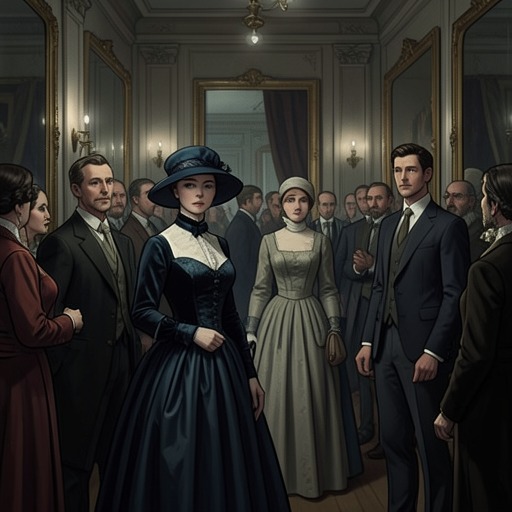
Musical Performance at the Lu Family Birthday Banquet
CEO's Beloved Honey GirlThe Musical Performance at the Lu Family Birthday Banquet is a social showcase in which Su Xiangwan transforms an unexpectedly arranged family gathering into a decisive demonstration of artistic ability. Lu Xun first accompanies her at the piano, but the evening quickly expands into a sequence of performances on multiple instruments. What begins as a gesture of protection and encouragement ends with the assembled guests abandoning their objections to Su Xiangwan, while the exhaustion imposed by their demands reveals the pressure hidden beneath the spectacle.
Circumstances and Social Stakes
The performance is arranged under hurried circumstances. Lu Xun has only just learned that Shen Hui is holding a small party at home and that the occasion is his mother-in-law’s birthday, leaving Su Xiangwan roughly half a day to prepare a dress and a present. The sudden notice makes the banquet less a carefully planned celebration than a social test: she must enter an established family setting with little time to prepare and face guests whose judgments are already shaped by status, reputation, and shifting loyalties.
The room also carries unresolved personal tensions. Song Yuner is present, and Su Qingrou’s position is burdened by her own conflict with Lin Yanche. The banquet therefore operates on two levels. It is a birthday gathering, but it is also a public arena in which women connected to powerful families are watched, compared, and challenged. Su Xiangwan’s performance provides a form of evidence that cannot easily be dismissed: instead of arguing for her place, she makes the room listen.
The Opening Piano Performance
Lu Xun initiates the central scene by taking Su Xiangwan’s hand and leading her toward the piano. He presents her shyness as the reason he will play the first song with her, positioning himself as both companion and shield. The gesture gives her a protected entrance while simultaneously making their alliance visible to everyone present. A child near Shen Hui responds with delight, treating the pair’s joined performance as an uncomplicated moment of celebration rather than a contest of adult loyalties.
The first piece is Ode to Joy, and the room falls silent as soon as the music begins. Lu Xun mainly provides the accompaniment while Su Xiangwan remains the principal player. That division matters: his presence helps her enter the scene, but the musical substance belongs to her. After the song, Lu Xun leaves at the appropriate moment, allowing her ability to stand without his direct support.
Su Xiangwan then continues alone, moving from Chopin’s Nocturne to popular songs. Although she has not played the zither for a long time, the instruments and repertoire are not unfamiliar to her. After more than a dozen songs, she is reluctant to stop. The audience’s response changes from polite attention to open astonishment, with particular praise for the complexity and vividness of the pieces attributed to her performance, including Dvorak’s Humor and the song Grief.
Song Yuner’s Challenge and Su Xiangwan’s Response
The applause does not end the social contest. Song Yuner approaches and emphasizes that she has heard Su Xiangwan is proficient in other instruments. She proposes that Su Xiangwan continue for the guests, naming the violin, zither, and accordion as possible choices. The request sounds like admiration, but its timing and public form make it a challenge: Su Xiangwan has already attracted attention, and Song Yuner attempts to decide whether that acclaim can survive another test.
Su Xiangwan does not answer defensively. She closes the piano, rests one hand against her cheek, and proposes that Song Yuner choose an instrument so that the two of them can play whichever one is selected. The offer reverses the pressure. Song Yuner picks up the violin but immediately puts it down, leaving her visibly awkward. Su Qingrou then sharpens the embarrassment by recalling that Song Yuner’s earlier rendition of Happy Birthday was the more suitable performance and implying that the violin would expose her inability to repeat even that simpler task. Song Yuner glares at Su Qingrou, breaks free when Su Qingrou hooks an arm around her shoulder, and leaves arrogantly.
The exchange gives the performance its clearest competitive edge. Song Yuner tries to turn musical proficiency into an instrument of humiliation, but Su Xiangwan’s calm counterproposal forces the challenge into a form that Song Yuner cannot comfortably accept. Music becomes a public language of social power: the person who appears to be asking for entertainment is actually testing rank, while the person who seems quiet controls the terms of the contest.
The Multitude of Instruments
After the disturbance, Su Xiangwan moves to the zither and explains that Shen Hui loves High Mountains and Running Water. She presents the choice modestly, saying she hopes the birthday celebrant will like it, and Shen Hui welcomes the offering. The performance changes the emotional temperature of the evening. Shen Hui’s smile does not fade whenever she looks toward Su Xiangwan, suggesting that the music has achieved what hurried preparation and formal gifts could not: it has created an immediate bond between guest and honored family member.
High Mountains and Running Water leaves the audience unable to remain seated, and applause follows continuously. Su Xiangwan then plays the violin, accordion, erhu, and pipa as well. The astonishment lies not only in the number of instruments but in the apparent naturalness with which she handles each one. Every new performance overturns the guests’ previous assumptions about the limits of her training. Their initial uncertainty gives way to the question of how long she must have studied and how she can make every instrument seem as though it belongs to her.
This sequence turns the banquet into a progression of reversals. The first song establishes competence; the zither performance establishes emotional and cultural fluency; the later instruments make competence appear almost inexhaustible. Su Xiangwan does not deliver a single impressive act and then retreat. She repeatedly crosses the threshold at which the audience thinks it has understood her, forcing it to revise its judgment again and again.
Consequences and Narrative Significance
By the end of the performance, no one present dares raise an objection to Su Xiangwan. The social meaning of the evening is therefore larger than entertainment. Before she plays, she is vulnerable to gossip, comparison, and the authority of people who believe they can assess her. After she plays, the audience must acknowledge a form of distinction that cannot be reduced to marriage, family affiliation, or protection by Lu Xun.
Yet the triumph carries a physical cost. The guests want to hear more, but Shen Hui notices that Su Xiangwan is too tired and orders music and dancers so that the banquet can move on. The decision prevents the public celebration from consuming her completely. Her success has made her the center of attention, but it has also made her body available to continued demands; the transition to dancing restores a boundary between admiration and exploitation.
The event also illuminates the wider pressures surrounding the characters. Su Xiangwan’s performance occurs against a background of coercive relationships, family secrecy, illness, and emotional injury. Su Qingrou’s silent suffering and the marks left by Lin Yanche’s violence, the memory of Su Xiangwan’s mother walking onto a balcony after concealing a terminal illness, and Lu Xun’s recollection of being kidnapped at twelve all belong to the same narrative world. In that world, bodies are often controlled, injured, or forced to bear hidden histories. The banquet offers a contrasting use of the body: Su Xiangwan directs her hands, breath, and practiced movement toward an audience, converting vulnerability into visible agency.
The performance therefore functions as both celebration and public reclassification. Lu Xun’s opening accompaniment gives Su Xiangwan a safe entry, Song Yuner’s challenge tests the stability of her new standing, and the succession of instruments makes that standing undeniable. Its final image is not simply a virtuoso display but a negotiated victory: Su Xiangwan wins recognition through performance, while Shen Hui’s intervention acknowledges that even a dazzling public triumph must eventually yield to rest.